Showing posts with label plant varieties. Show all posts

Tuesday, 18 September 2012

Indigenous / Native Food Garden


The first plants in the Northcote Library Food Garden’s indigenous/native* food garden are in and appear to be enjoying their new home at the Southern end of the garden.

The indigenous/native garden was proposed way back in April last year in the community consultation phase of the garden’s establishment.  Members of the local community felt it would be fitting and beneficial to include an area that showcased the growing of native and local indigenous plants within the garden and the gardening group earmarked the project early on as an important ‘Phase 2’ action.  The indigenous/native garden’s inclusion is an exciting step towards the educational and sustainability vision for the NLFG as outlined by the community in 2011.

We feel the inclusion of the indigenous garden offers benefits including:
  • Educational – people can familiarise themselves with native bush food plants and see their viability.  Visitors will be able to observe edible natives and even taste the produce, possibly encouraging them to plant more bush foods in other private and public spaces.
  • Biodiversity – having a native food forest alongside the existing exotic food forest and vegetable gardens encourages pollinators such as bees, and attracts native birds to the area, which will eat insects and provide more natural pest control.
Gardeners tidy up existing native vegetation
The site includes many established native plants including eucalypts, grevilleas, correas, callistemons and acacia and these plants were maintained as an essential part of the ‘native food forest’.

The project had three phases:
1.  Identification of the existing native plants
2.  Researching and identification of suitable indigenous and native food plants for inclusion
3.  Tidying of the site, acquisition and planting of the first plants

The native forest garden design incorporates the existing natives from the tall eucalypts to the prostrate grevilleas to create a multi-layered native ecosystem. New plants were sourced from our local native plant experts VINC and other local nurseries.  All plants are labelled clearly and we plan to add further signage and annotations in the future.  Delicate varieties such as yam daisy (Microseris lanceolata), chocolate lily (Arthropodium strictum), vanilla lily (Arthropodium milleflorum), and bulbine lily (Bulbine bulbosa) are being grown in large pots at present so as to not be ‘overwhelmed’ and lost in the garden.  

Credit must go to Angelo and Damien, of the NLFG’s advisory group, who gave their time, expertise and enthusiasm to the project and several of our gardeners who, through their research and hard work, were instrumental to the project’s success.

The indigenous/native garden is an ongoing project and will be added to over time.

Pruning off lower branches on the newly planted macadamia tree

Useful links:
Merri Creek Management Committee - http://www.mcmc.org.au/


* Please note that here we have used the term indigenous to denote plants that are indigenous to the local Darebin area and native as plants that are indigenous to Australia, but not necessarily to the local area.

Matted Flax Lily  (Dianella amoena)
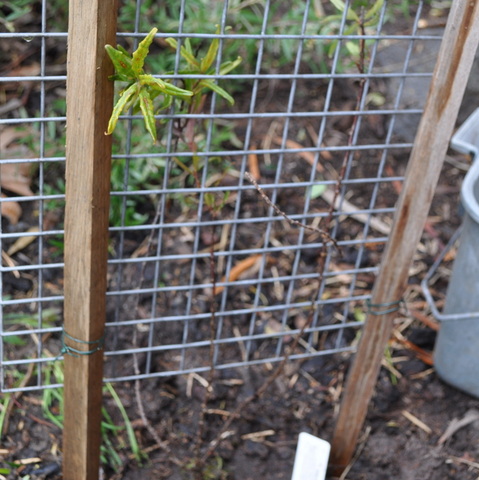
Native Mint (Menthos Australis) protected by twiggy tripod
Native Mint (Menthos Australis)
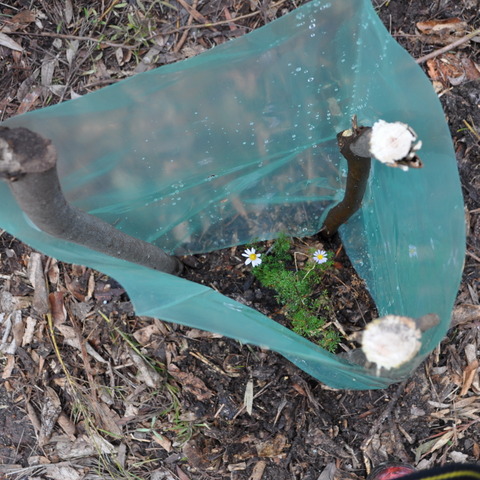
Cut Leaf Daisy (Brachyscome multifida) protected by plastic cover
Chocolate Lily (Arthropodium strictum) 
planted in pots to protect delicate foliage
Small-Leaf Bramble or Native Raspberry (Rubus parvifolius)
Common Apple Berry or Dumpling Apple (Billardiera scandens)
Nodding Salt Bush (Einadia nutans)

Text for this article has been contributed by Allison and Angelo

Sunday, 13 May 2012

Jerusalem Artichokes


Our Jerusalem artichokes were planted during our first planting day in July 2011.  The tubers went into the ground in an area earmarked for perennial planting with a bit of discussion that included warnings from the experienced amongst us, “Be careful or they’ll take over!”.  They were buried at about twice their depth (20 centimetres or so) and were not much thought about again, until they began emerging from the ground with the sunflowers at the start of Summer.

No reading about Jerusalem artichokes seems complete without mention of their perplexing misnomer, being neither an artichoke, nor from the Middle East.  They are actually an edible tuber that, according to the seasoned cooks in our gardening group, can be roasted with a bit of garlic and butter and eaten thus, or turned into a delicious soup.

The tall plants (two metres plus)  flowered in late Summer with large daisy-like yellow flowers and could have been confused with the nearby sunflowers, but for their more spindly form.  They appeared to cope well without any attention or extra maintenance at all, even in the alkaline soil conditions that the NLFG has offered in the first year.  A quick read on the Gardening Australia website reveals, however, that they do enjoy a rich, well-drained soil and benefit from some added fertilizer from time to time. 

Image from tinyfarmblog.com
The gardeners decided to harvest some of the tubers on our late April gardening day.  At this stage, the plants were still green, but they can be harvested after the leaves wilt at the beginning of Winter as well.  From a handful of tubers that were planted last year, we harvested a couple of kilograms of Jerusalem artichokes.

It also seems negligent to write about Jerusalem artichokes without alluding to their potentially...ahem...windy side-effects.  Tamara and Ducky have experimented to reduce The Fartichoke Effect and, short of standing downwind at your next social gathering, it may just be worth a go.

Harvesting Jerusalem artichokes - April 2012

The hat runneth over!  Some of our tuber harvest.
See also:

Tuesday, 11 October 2011

Summer 2011-12 Plan

Devising the Plan
A group of gardeners met in late September to devise a plan for the communal planting, care and harvest of the Northcote Library Food Garden for the Summer 2011-12 season.  The result of the meeting is the map of the garden below, that incorporates the planting (and consumption!) wants of the gardeners with sustainable gardening and permaculture principles.  The plan will be used on the Community Gardening Days to inform ongoing planting and garden care and can be consulted when gardeners work in the garden in their own time.


Northcote Library Food Garden Summer 2011-12 Plan (devised September 2011)


Features of the Summer Plan
Succession Planting - Spaced planting of different varieties of tomatoes, beans, eggplants, zucchinis, green varieties etc. will ensure that is food to harvest throughout early, mid and late Summer.
Bean Tee-Pee -  A tee-pee has been created that will become a living, bean-producing cubby for children.
North-South staking - Tall varieties of plants, including tomatoes and beans, have been staked in rows running North-South to limit shading of plants growing behind them.
"Three Sisters" Planting - Sweetcorn seed, squash and climbing beans have been planting together in a large bed area.  The corn will become a living trellis for the beans to grow up and the squash will trail around the taller bean and corn plants.
Garden Hot Spot - The bed behind the water tank abuts a brick wall and will become a hot and exposed bed during warmer weather.  As a result, we have planted heat-loving vegetables there: eggplants, capsicums and chillies.
Melons - Watermelons, as the name suggests, are thirsty!  They've been planting close to the water tank.

Monday, 12 September 2011

Guide to Year Round Fruit

In one of the NLFG's inaugural workshops, John Pinnegar, of the Heritage Fruit Society, shared some of his knowledge about growing fruit trees locally and developed this fabulous guide to having fruit year-round in a Melbourne garden.

John Pinnegar's Guide to Year-Round Fruit in Melbourne

Dec/Jan
Feb
Mar
Apr
May
Jun
Jul
Aug
Sep
Oct
Nov
Plums (early, mid & late varieties)
Persimmon
Pecans
Citrus: orange, grapefruit, mandarin, lemons, cumquat etc.

Raspberries
Apricots
Apples (early, mid & late varieties)
Guava

Loquat
Peaches
Avocadoes
Olives
Fejoia

Blueberries
Cherries

Grapes
Kiwi Fruit

Pomegranate


Mulberries
Figs
Quince


Blueberries
Pears
Nuts: almonds, chestnuts, walnuts
Passion fruit
Raspberries (Autumn fruiting)


John's Pick of the Fruit Trees
Guava - fruits in Winter, great taste, high in Vitamin C, can be pruned into any shape and used as a hedging plant
Calmondin Cumquat - larger sized cumquat, juice can be used instead of lemon or lime in cooking (when you need just a squeeze without wasting a whole lemon!)


John discusses fruiting plants with a workshop group at the Garden Launch

Sunday, 31 July 2011

The First Winter


The First Planting Day
Our first planting day was a great success.  The sun shone brilliantly all day and the Winter gardeners, visitors and Friends of the Garden managed to complete a mass planting out, as well as learn a great deal from the experts present.  We were gifted with a large number of plant donations and the NLFG thanks its supporters including John Pinnegar, Peppertree Place Coburg, Angelo Eliades and Bunnings Preston, as well as countless individuals who donated cuttings and seedlings.

Pathways marked out ready for planting

Plum trees in the Food Forest

The back garden bed.  Look at all those plants!

Watering in at the end of the day

The Winter Season

Despite the slow growing season, planting out a new garden in Winter has provided an excellent opportunity to plant bare-rooted fruit trees, berry canes and root crops, and to establish perennial ornamentals and edibles in new homes.

The Food Forest has taken great shape under the direction of Angelo Eliades of Deep Green Permaculture.  Three plum trees (Santa Rosa, D’Agen and Donsworth), three apples, and a mulberry tree now stand as the forest canopy, with a dwarf mandarin, berries (raspberries, currents and a jostaberry), and scented and companion plants forming the mid-layer.  Ground covers include wild (alpine) strawberries, lettuce, Asian greens, herbs and violets.

The Food Forest Plan - Angelo Eliades

Winter edible planting throughout the garden includes strawberries, potatoes, cabbage, broccoli, cauliflower, tat soi, bok choi, Chinese cabbage, kale, silverbeet and rainbow chard, garlic, onions, leek, spring onions, edible cannas, lettuce varieties, mustard, parsley, coriander, watercress, dill, Warrigal greens, Jerusalem artichoke, rhubarb, nasturtium and broad beans.

Companion, scented and flowering plants form an important part of the garden and a third of the front garden bed has been planted with a variety of plants including lavender, daisy varieties, calendula, cornflower, hollyhock, salvia varieties, as well as some native ground covers and shrubs.  These plants are dotted throughout the seasonal beds as well and will act as bee forage, attract beneficial insects to the garden and act as ‘helpers’ to our fruit and vegetable varieties.

August in the Garden
  • Trellis will be erected for the berries in the Food Forest, an additional berry bed and for a planned passion fruit plant near the water tank. 
  • Pathway construction awaits some enthusiastic volunteers!  Stepping stones will criss-cross the garden beds and the Food Forest and will allow for easy access to plants.  We plan to construct these paths from reclaimed and re-purposed materials, such as bricks and timber.
  • Succession planting will be an ongoing task in the garden and the back garden bed has been planned to ensure there will be food to harvest every month from the garden.
  • Growers will begin to propagate seed for the coming Spring season this month and we’re hoping to grow some interesting heritage/heirloom varieties.


The Darebin Council Sow What When brochure is helping to inform us of suitable planting times as well as the plants that do and do not get along together!

The next planting and working bee day is on Saturday August 20th from 10am.